RV Maintenance Costs: What to Budget per Year
Most new RV owners get blindsided by their first year of upkeep. You budget for the loan payment and maybe insurance, then a roof seal fails or the water heater dies, and suddenly you're staring at a repair bill you never planned for. RV maintenance costs don't follow a neat monthly pattern like a car payment, and that catches people off guard.
Here's the direct answer: most owners spend between $1,500 and $5,000 per year on routine upkeep and repairs, depending on the rig's age, class, and how often you're on the road. That range covers oil changes, roof inspections, tank cleaning, and appliance servicing, but it climbs fast once you factor in slide-out motors, awning replacements, or what it costs to repair an RV air conditioner that fails mid-trip.
This article breaks down exactly where that money goes. You'll see routine maintenance costs by category, what major repairs typically run, and the hidden expenses that don't show up until you're already stuck at a campground. Whether you're a weekend traveler or living in your rig year-round with a list of full time RV living tips to work through, you'll walk away with numbers you can actually plan around.
Why RV maintenance costs matter for your budget
An RV isn't just a vehicle, it's a house on wheels, and that combination is exactly why RV maintenance costs deserve real attention in your budget. A truck or car has an engine, transmission, and tires to worry about. Your rig has all of that plus a roof membrane, water heater, holding tanks, slide-out mechanisms, and an electrical system running on both shore power and battery. Every one of those systems ages and fails on its own schedule, and skipping upkeep on any single one can snowball into a much bigger bill.
Deferred maintenance compounds fast
Water damage is the clearest example of why this matters. A tiny gap in roof sealant costs about $20 in caulk and twenty minutes of your time to fix, and a quick roof inspection to spot leaks early is what catches it. Ignore it for a season, and water works its way into the roof decking and wall studs, and now you're looking at a $3,000 to $10,000 structural repair. The same logic applies to tank sensors, appliance seals, and brake components. Deferred maintenance rarely stays cheap; it just moves the cost further down the road and multiplies it.
A $20 tube of sealant today beats a $5,000 roof repair next year.
Resale value depends on your maintenance record
Beyond avoiding disasters, consistent upkeep protects what you paid for the rig in the first place. Buyers working from a pre-purchase RV inspection checklist can tell the difference between an RV that's been serviced on schedule and one that's been neglected. Soft spots in the floor, corroded battery terminals, or a musty smell from old tank buildup all knock thousands off a resale price, even if the unit still runs fine. Setting aside money for routine RV upkeep every year is really an investment in what you'll get back when you sell or trade in.
Unplanned repairs disrupt your travel plans
Finally, there's the trip-interruption factor that budgets often ignore. Owners who skip a line item for maintenance tend to treat every repair as an emergency, which means paying rush rates for a mobile technician and losing days of a trip waiting on parts. Planning for RV maintenance cost ahead of time, rather than reacting to breakdowns, keeps small problems small and keeps you on the road instead of stuck at a campground office trying to find help.
How to estimate your annual RV maintenance budget
Most financial planners for RVers point to a simple rule: set aside 1% to 4% of your rig's purchase price every year for upkeep and repairs. A $40,000 travel trailer lands you around $400 to $1,600 annually, while a $150,000 Class A diesel pusher can run $1,500 to $6,000, so it helps to know how much an RV costs by type before you set the percentage. This isn't a guarantee, but it gives you a starting number instead of guessing blind.
Budget by percentage of purchase price, not by hoping nothing breaks.
Adjust the baseline for age and usage
Older units and full-time travelers need to push toward the higher end of that range. A 15-year-old fifth wheel has seals, hoses, and appliances nearing the end of their expected lifespan, and a rig that's on the road 200 nights a year takes far more wear on suspension, tires, and slide mechanisms than one parked at a seasonal site. Weekend warriors with newer units can often plan closer to the 1% to 2% mark.
Break the number into categories
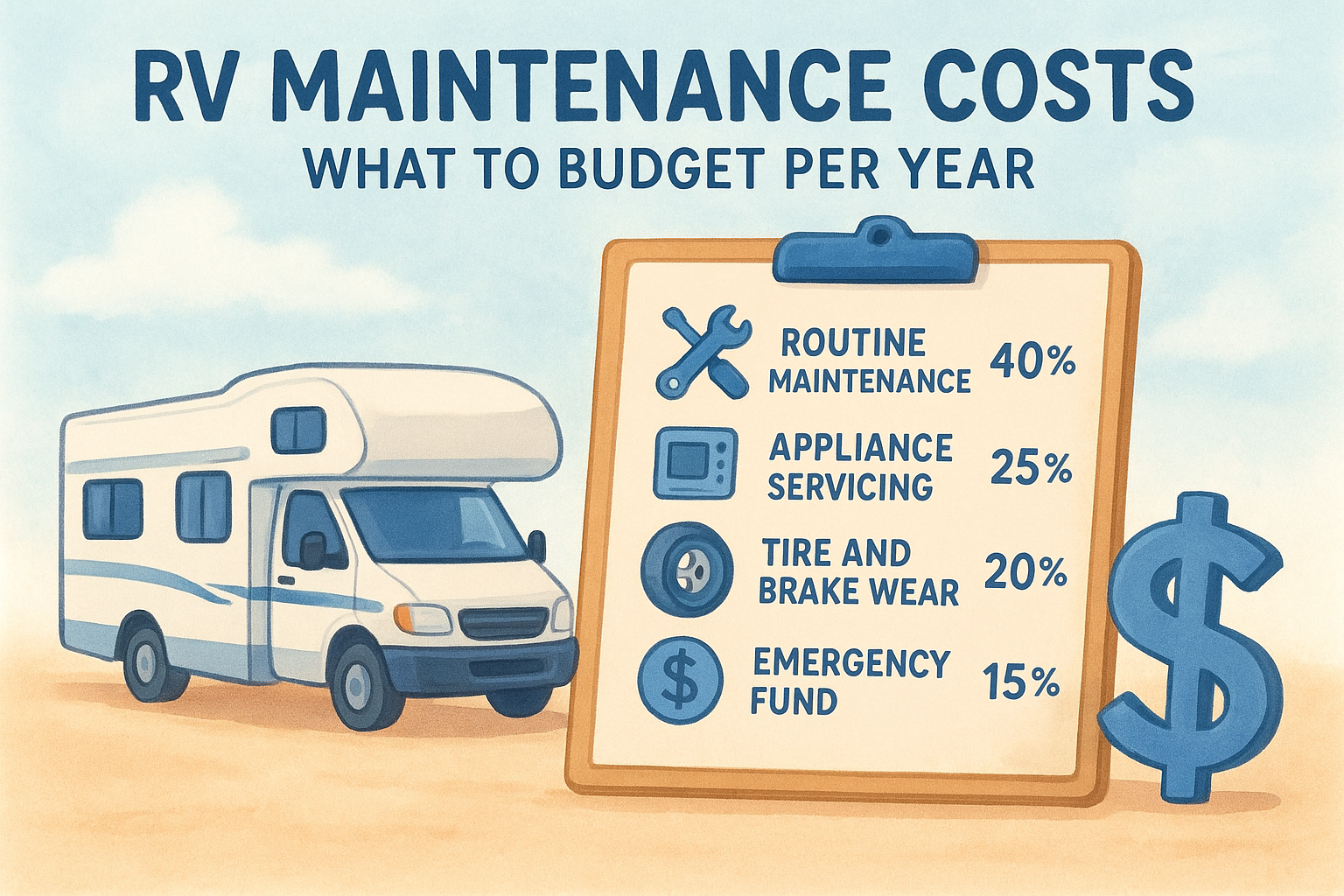
Once you have a yearly total, split it into buckets so you're not caught flat when one system needs work:
- Routine maintenance (oil changes, tank cleaning, roof inspections): 40% of the budget
- Appliance and system servicing (water heater, AC, fridge): 25%
- Tire and brake wear: 20%
- Emergency repair fund: 15%
Track spending to refine your estimate
Keep a simple log of every repair, part, and service call for at least one full year. Reviewing that log tells you whether your specific rig runs hot or light compared to the general percentage rule, and it gives you real numbers to plan next year's budget instead of a guess pulled from an article.
Typical RV maintenance costs by category and RV type
Numbers get more useful once you break them down by what you actually own. A travel trailer, a Class A motorhome, and a fifth wheel don't share the same wear points, and RV maintenance costs shift depending on how many systems your rig carries. A towable has no engine to service, but it still has axles, brakes, and a roof. A motorized rig adds an engine, transmission, and generator into the mix, which pushes the total higher every year.
Cost breakdown by category
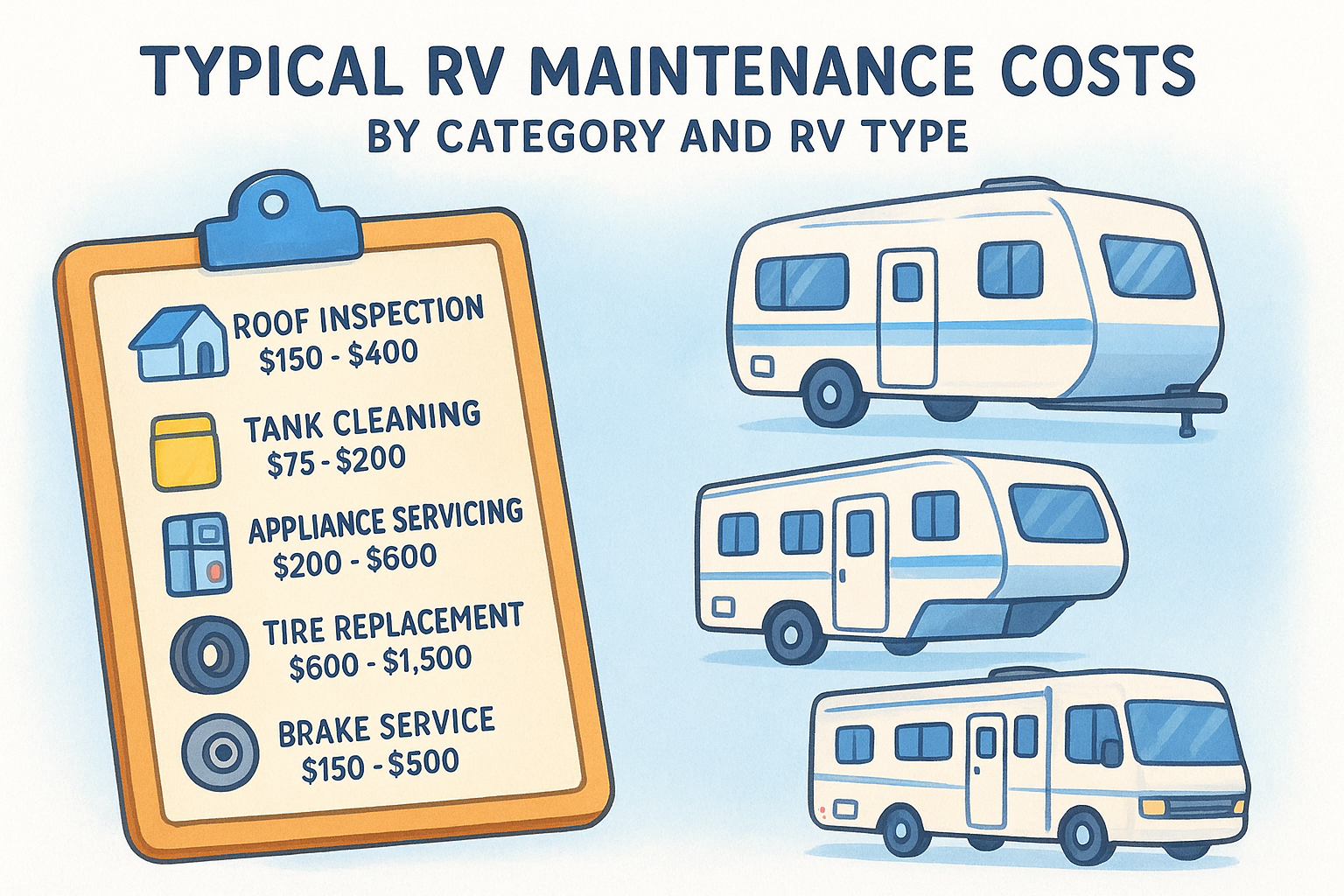
Here's what typical annual spending looks like across the categories most owners deal with:
Roof inspection and resealing $150 - $400 Tank cleaning, flushing, and sanitizing and sensor service $75 - $200 Appliance servicing (fridge, water heater, AC) $200 - $600 Tire replacement (every 3-6 years) $600 - $1,500 Brake service $150 - $500 Engine and generator maintenance (motorized only) $300 - $900 Slide-out and awning upkeep $100 - $350A towable RV skips engine costs entirely, but it still needs the same roof, tank, and appliance care as a motorhome.
How RV type changes the total
Fifth wheels and Class A motorhomes sit at opposite ends of the spending scale. Fifth wheels tend toward the lower end of routine costs since there's no drivetrain, but their larger roofs and multiple slides mean more seals to maintain. Class A and Class C motorhomes carry the added weight of engine oil changes, transmission fluid, and generator servicing, which alone can add $300 to $900 a year. Truck campers and small travel trailers sit at the bottom of the range simply because they have fewer systems to fail.
Owners who don't want to track every category themselves can use a service like MobileRVService.com to find a vetted technician who handles the routine list in one visit, which keeps the per-system guesswork out of your annual budget.
Hidden RV costs that catch owners off guard
Even owners who budget carefully get surprised by expenses that never show up in a typical maintenance checklist. These costs sit outside the routine categories, and they're the reason many people underestimate their real RV maintenance cost every year.
Winterization and de-winterization
Storing your rig for the off-season isn't free. Blowing out lines, adding antifreeze, and working through a spring de-winterizing start-up runs $150 to $350 per visit if you hire it out, and skipping it even once risks a cracked water heater or burst pipe that costs thousands more.
Mobile technician callout fees
A shop visit and a driveway repair aren't priced the same way. Mobile RV repair techs charge a trip or diagnostic fee, often $75 to $150, on top of labor and parts, especially for emergency or after-hours calls. That fee buys you convenience, but it's easy to forget when you're penciling out a yearly budget.
Convenience has a price tag, and forgetting it is how budgets fall short.
Parts availability and shipping delays
RV-specific parts, like a particular slide motor or a discontinued appliance model, often aren't sitting on a local shelf. Shipping delays can add days to a repair and sometimes force you into a pricier expedited order just to get back on the road.
Storage and campground fees during repairs
Getting stuck waiting on a part or a technician means paying for a campsite or storage lot longer than planned. Here's a quick list of the extras owners commonly forget:
- Winterization/de-winterization: $150-$350
- Mobile service call fees: $75-$150
- Expedited parts shipping: $50-$200
- Extended campground stays during repairs: $30-$80/night
Holding a small cushion for these line items keeps a routine repair from turning into a budget crisis mid-trip.
Staying ahead of RV maintenance costs
Budgeting for RV maintenance costs comes down to treating your rig like the house and vehicle it actually is. Set aside that 1% to 4% every year, break it into categories, and keep a cushion for the hidden extras like winterization and callout fees. Owners who plan this way rarely get blindsided by a $3,000 roof repair or a dead water heater mid-trip.
Surprises still happen even with the best budget. Sourcing the right part fast often decides whether a small repair stays small or turns into a week stuck at a campground waiting on shipping. That's where having a direct line to parts matters as much as having cash set aside. Skip the delays and order RV parts online through our platform, and keep your travel plans intact instead of parked in a service lot.