16 Must-Know Full Time RV Living Tips For Beginners In 2026
So you're thinking about ditching the mortgage, selling most of what you own, and hitting the road in an RV. Maybe you've binge-watched YouTube videos of couples working remotely from national parks, or you've run the numbers and realized full time RV living tips from people who've actually done it could save you from some expensive mistakes. Either way, you're not alone, hundreds of thousands of Americans now call an RV home year-round, and that number keeps climbing.
But here's what the glamorous Instagram posts won't tell you: full-time RV life involves a steep learning curve. From figuring out mail forwarding and health insurance to knowing when your roof seals need replacing, the logistics can feel overwhelming before you even turn the key. Small oversights, like skipping routine maintenance or choosing the wrong domicile state, can cost you thousands of dollars and a lot of frustration down the road.
That's exactly why we built MobileRVService.com. We connect RV owners with over 3,200 mobile technicians across North America who come to you, wherever you're parked. When something breaks at a campground in rural Montana, you shouldn't have to tow your rig 90 miles to a dealership. We've helped enough full-timers solve roadside problems to know what trips people up most, and we put that knowledge into this guide.
Below, you'll find 16 practical tips covering everything from budgeting and route planning to maintenance schedules and connectivity on the road. No fluff, no theory, just actionable advice from real experience to help you start full-time RV life with your eyes open and your systems dialed in.
1. Create a breakdown plan with MobileRVService.com
Most new full-timers spend months researching routes and campgrounds but zero time planning for the inevitable: something breaks. Among all the full time rv living tips you'll encounter, having a breakdown plan ready before you need it is the one that will save you the most stress and money when you're three states from anyone you know.
Why it matters
A breakdown without a plan turns into a panic spiral fast. You're stuck at a campground, your slide won't retract, and you're spending hours cold-calling shops that don't service your rig or don't have availability for two weeks. Mobile technicians come to you, which means you don't have to tow a 35-foot coach to a dealership, but you still need to know how to find a qualified one quickly.
The difference between a two-hour fix and a two-day nightmare often comes down to whether you already had a service network ready to call.
Your RV's roof seals, electrical system, and slides are the three most common failure points on full-time rigs. Each one can become a trip-ending problem if you don't have someone lined up fast. Building your plan before you leave gives you options instead of desperation.
What to do
Start by creating an account on MobileRVService.com before your first long trip. Search your home zip code and your first three destination areas to see which technicians are available along your route. Save two or three provider profiles from each region so you have backup options in case your first call isn't available.
Consider upgrading to the VIP Membership if you're traveling through remote areas. The concierge service finds a qualified technician for you when you can't locate one independently, which matters most when you're parked somewhere rural with no signal and a propane leak to sort out. Keep your rig's year, make, model, and VIN saved somewhere accessible, because every technician will ask for those details immediately.
Rookie mistakes to avoid
New full-timers frequently wait until something breaks before searching for help, which leaves them choosing from whoever picks up the phone rather than whoever is most qualified. Don't do that. Build your contact list during route planning, not roadside.
Also, don't assume campground staff can recommend someone reliable. They often hand out cards from whoever paid for a bulletin board spot, not from technicians with verified track records.
2. Set a realistic budget and track it weekly
Most people underestimate the true cost of full-time RV living before they start. Getting your numbers right early is one of the most important full time rv living tips you'll find, because budget surprises hit harder when you have no fixed home to fall back on.
Why it matters
Your expenses on the road don't look like your expenses at home. Campground fees, fuel, and unexpected repairs all fluctuate week to week based on where you travel and how far you drive. Without weekly tracking, small overages in fuel or dining compound into a significant shortfall by month's end.
A solid budget isn't just a financial tool. It determines where you can actually afford to go next week.
What to do
Build your budget around five core categories and review every line at the end of each week, not each month:
- Campground fees: $400 to $900 per month depending on your mix of paid parks and free camping
- Fuel: budget based on your rig's actual MPG and planned mileage
- Food and propane: $400 to $600 per month for two people
- Insurance: health, RV, and roadside coverage combined
- Maintenance reserve: at least 10% of your total monthly budget set aside and untouched
Rookie mistakes to avoid
New full-timers frequently forget to include dump fees, laundry, and campground reservation fees in their base numbers. These small costs add up to $100 or more monthly and catch people off guard.
Another common error is treating the maintenance reserve as available spending money during a cheap travel week. Keep it separate and untouched until an actual repair requires it.
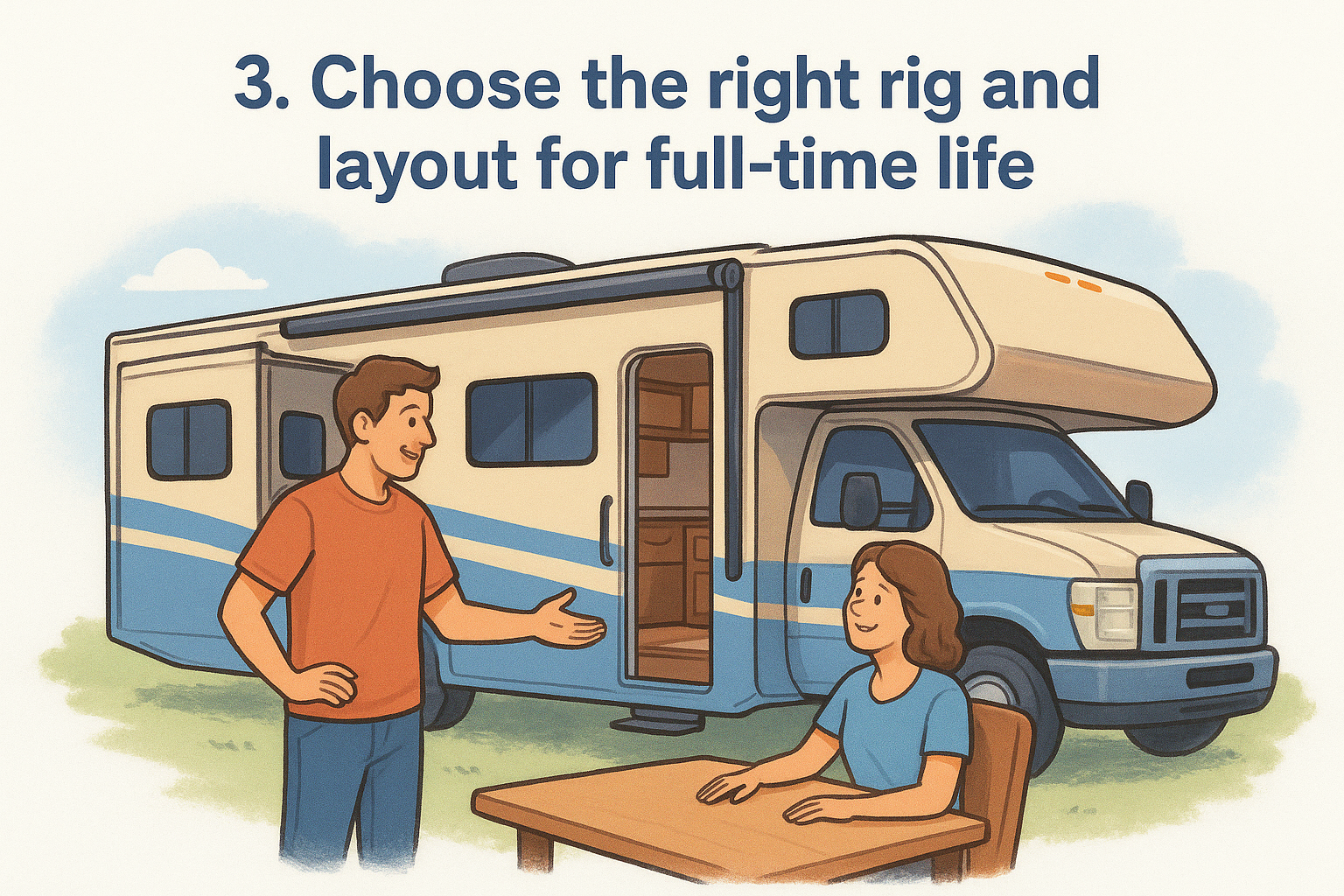
3. Choose the right rig and layout for full-time life
Your rig is your home, your vehicle, and your biggest ongoing expense rolled into one. Among all full time rv living tips, picking the right layout for how you actually live is the decision that has the longest-lasting impact on your daily comfort and your repair bills.
Why it matters
Not every RV is built for year-round, high-mileage life. Class A and Class C motorhomes tend to handle full-time use better than travel trailers if you plan to move frequently, because you're not constantly hitching and unhitching in tight campgrounds. However, fifth wheels offer more living space per dollar and often feel more like a real home if you stay put for longer stretches.
The floor plan you choose will determine your storage capacity, sleeping arrangements, and how well two people can coexist in 300 square feet.
What to do
Visit rigs in person before you buy. Sit at the dinette, open every cabinet, and walk the slide fully extended to see if the layout actually works for your daily routine. Prioritize a dedicated workspace if you work remotely, a full-size bed you don't have to convert nightly, and enough exterior storage for tools and outdoor gear.
Check the rig's GVWR against its dry weight to understand how much cargo you can realistically carry before you're overloaded.
Rookie mistakes to avoid
Many beginners buy based on photos alone and discover the layout frustrates them within the first month. Another common error is prioritizing slideouts without checking whether the rig fits at standard campground sites, particularly in state parks with tighter pads.
4. Downsize fast without regretting it later
Downsizing is one of the hardest parts of transitioning to full-time RV life, and dragging it out only makes it harder. Among full time rv living tips that actually save you money before you leave home, cutting your belongings decisively before your move date separates people who settle comfortably into their rig from those who spend months cramped by things they couldn't let go.
Why it matters
Every pound you carry costs you in fuel efficiency, tire wear, and cargo capacity. Your rig's GVWR is not a suggestion, and overloading it affects handling, braking distance, and long-term frame stress. Most full-timers also report they donated another 30% of what they packed within the first three months on the road.
The goal isn't to own less. It's to own only what earns its place in a limited footprint.
What to do
Sort everything into three categories and set a hard two-week deadline to finish the process before you load the rig:
- Keep: Multi-use gear, tools, clothing for your next climate, and digitized files
- Sell: Furniture, appliances, and duplicates that won't fit your new footprint
- Donate: Everything else with value that isn't worth the time to sell
Rookie mistakes to avoid
Many beginners rent a storage unit for sentimental items they aren't ready to part with. Paying $100 to $200 monthly to store things you haven't touched defeats the financial logic of full-time living. Another mistake is packing for every possible climate rather than where you're heading next. You can always buy a coat in Colorado if you need one.
5. Pick a domicile and handle legal basics early
Your domicile state is your legal home on paper, and choosing the wrong one can cost you significantly in taxes, registration fees, and insurance premiums. This is one of those full time rv living tips that people delay until it becomes urgent, but handling it before you leave protects you from legal and financial complications that are genuinely painful to untangle on the road.
Why it matters
Three states dominate the full-timer conversation: South Dakota, Texas, and Florida each combine no state income tax with accessible residency requirements. Your domicile determines your vehicle registration costs, health insurance options, and jury duty obligations, so the choice carries real weight in your annual budget.
Picking the wrong domicile state can cost you thousands of dollars per year in taxes and registration fees that a simple upfront decision would have avoided.
Delaying this decision means you may continue paying high state income taxes or elevated registration costs simply because you never updated your paperwork. Act before your first long trip, not after.
What to do
Research each state's residency requirements and compare them against your travel plans and financial situation before committing. South Dakota requires only a single overnight stay to establish residency, which makes it accessible for most travelers passing through. Update your driver's license, vehicle registration, and voter registration to match your new domicile before you leave.
Rookie mistakes to avoid
Many beginners keep their home state as their domicile out of habit, even when it costs them significantly more each year. Another common error is assuming your insurance carrier will automatically adjust coverage after a domicile change without receiving a direct notification from you.
6. Lock down mail, packages, and your address
Mail forwarding sounds like a minor detail until your driver's license renewal, tax documents, or medical insurance cards have nowhere to go. Among the practical full time rv living tips that most guides skip over, sorting out your mail system before departure saves you from chasing down critical documents while parked somewhere without reliable cell service.
Why it matters
Without a permanent mailing address, banks, insurance companies, and government agencies have nowhere to send correspondence that requires your attention. Some carriers also refuse to ship certain packages to forwarding services, which creates gaps in your ability to receive parts, prescriptions, or replacement gear on the road.
Your mailing address is the backbone of your legal and financial identity, and losing control of it creates problems that take months to untangle.
What to do
Sign up with a dedicated mail forwarding service before you change your domicile. These services receive your physical mail, scan the envelopes, and let you request forwarding or shredding on demand from an app. Set up a UPS Store mailbox or Amazon Locker account for packages that require a physical address in specific cities you visit regularly. Update every financial institution, subscription, and government account with your new mailing address as part of your pre-departure checklist.
Rookie mistakes to avoid
Many beginners use a family member's address as a convenience, which creates confusion when that person moves or can no longer manage your mail reliably. Another common error is forgetting to update your vehicle registration and insurance policies with your new mailing address after switching domicile states.
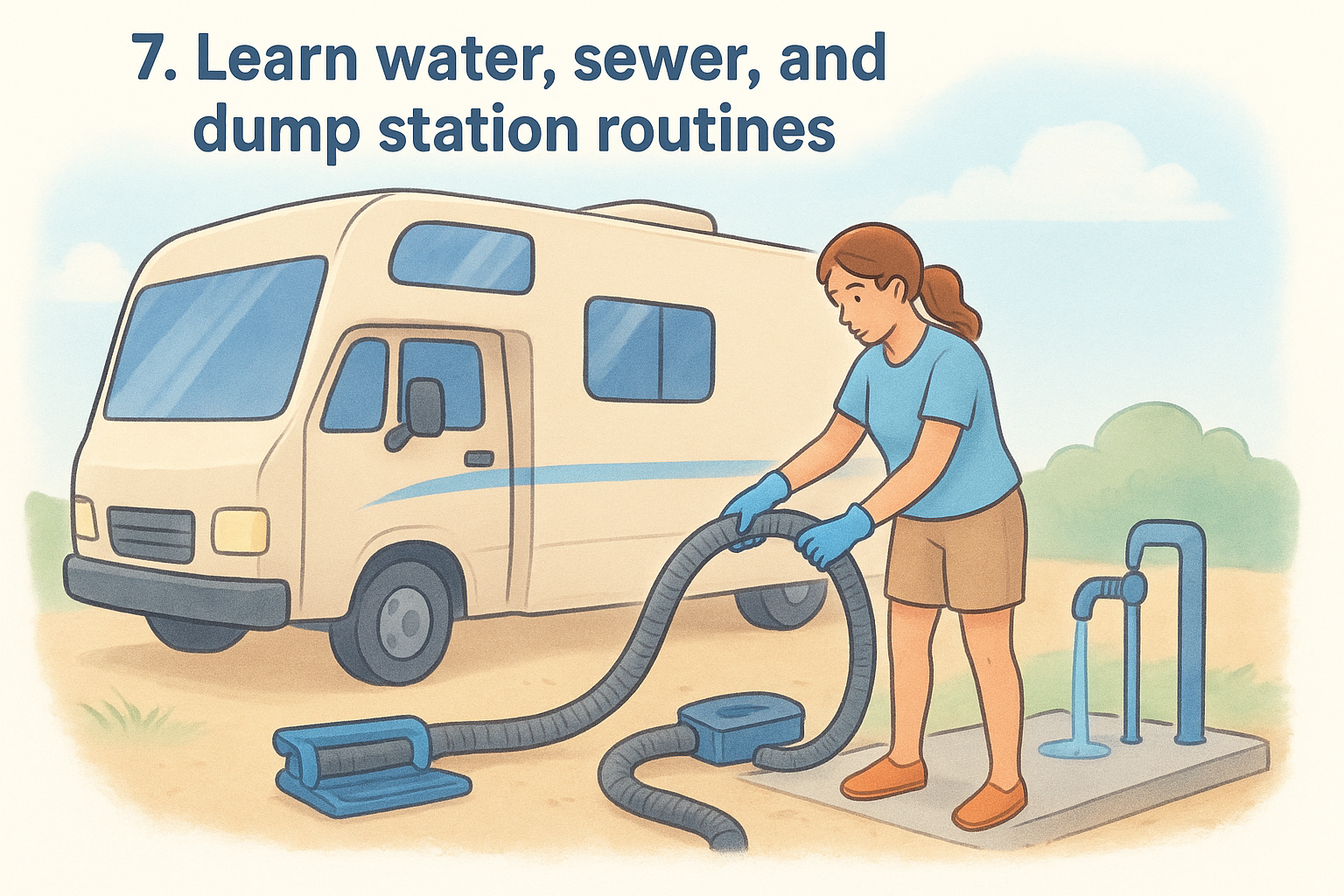
7. Learn water, sewer, and dump station routines
Among the full time rv living tips that catch beginners most off-guard, managing water and waste systems ranks near the top. Unlike a house, your RV operates on finite tanks that require active monitoring and a consistent routine to keep things running cleanly and safely.
Why it matters
Running out of fresh water or letting your black tank overflow are two of the most preventable problems full-timers face. Both happen because new travelers ignore their tank gauges until the system forces their attention. Proper tank management directly affects your health, your plumbing, and your campsite etiquette.
Developing a consistent dump station routine in your first month on the road will save you from some of the most unpleasant surprises full-time RV life can offer.
What to do
Check your fresh, gray, and black tank levels every morning as part of a daily walkthrough. Dump your black tank first, followed by your gray tank, so gray water flushes any residue from the sewer hose. Carry a quality sewer hose kit with multiple extension lengths so you can reach dump connections at awkward campsite angles. At dump stations, use disposable gloves every single time without exception.
Rookie mistakes to avoid
Many beginners leave their gray valve open at full hookup sites, which dries out the tank and causes odors over time. Keep the gray valve closed until you're ready to dump. Another common error is failing to carry enough fresh water capacity for nights at dry-camping sites, where no hookups are available and your onboard tank is your only supply.
8. Get your power setup right for your travel style
Your power setup determines where you can park, how long you can stay off-grid, and whether your work and daily routines actually function on the road. Among full time rv living tips that beginners consistently underestimate, understanding your energy needs before buying equipment saves you from expensive upgrades six months into the lifestyle.
Why it matters
Power requirements vary dramatically depending on whether you stay mostly at full-hookup campgrounds or spend significant time boondocking on Bureau of Land Management land or national forests. Running a laptop, refrigerator, and air conditioner simultaneously on a minimal battery bank will drain your system in hours and leave you without the basics when you need them most.
Getting your power system right before you leave home is significantly cheaper than retrofitting it on the road when time pressure forces rushed decisions.
What to do
Audit your actual power consumption by listing every device you use daily and checking its wattage. If you work remotely or camp off-grid frequently, a 200 to 400 amp-hour lithium battery bank paired with at least 400 watts of rooftop solar gives you realistic independence from hookups. Add a shore power connection and a generator as backup for cloudy weeks or high-draw days.
Rookie mistakes to avoid
Many beginners buy the smallest solar kit available thinking it will cover their needs, then discover it barely maintains their batteries without actually charging them from a depleted state. Another common mistake is ignoring your inverter's capacity, which limits which appliances you can run simultaneously even if your batteries are full.
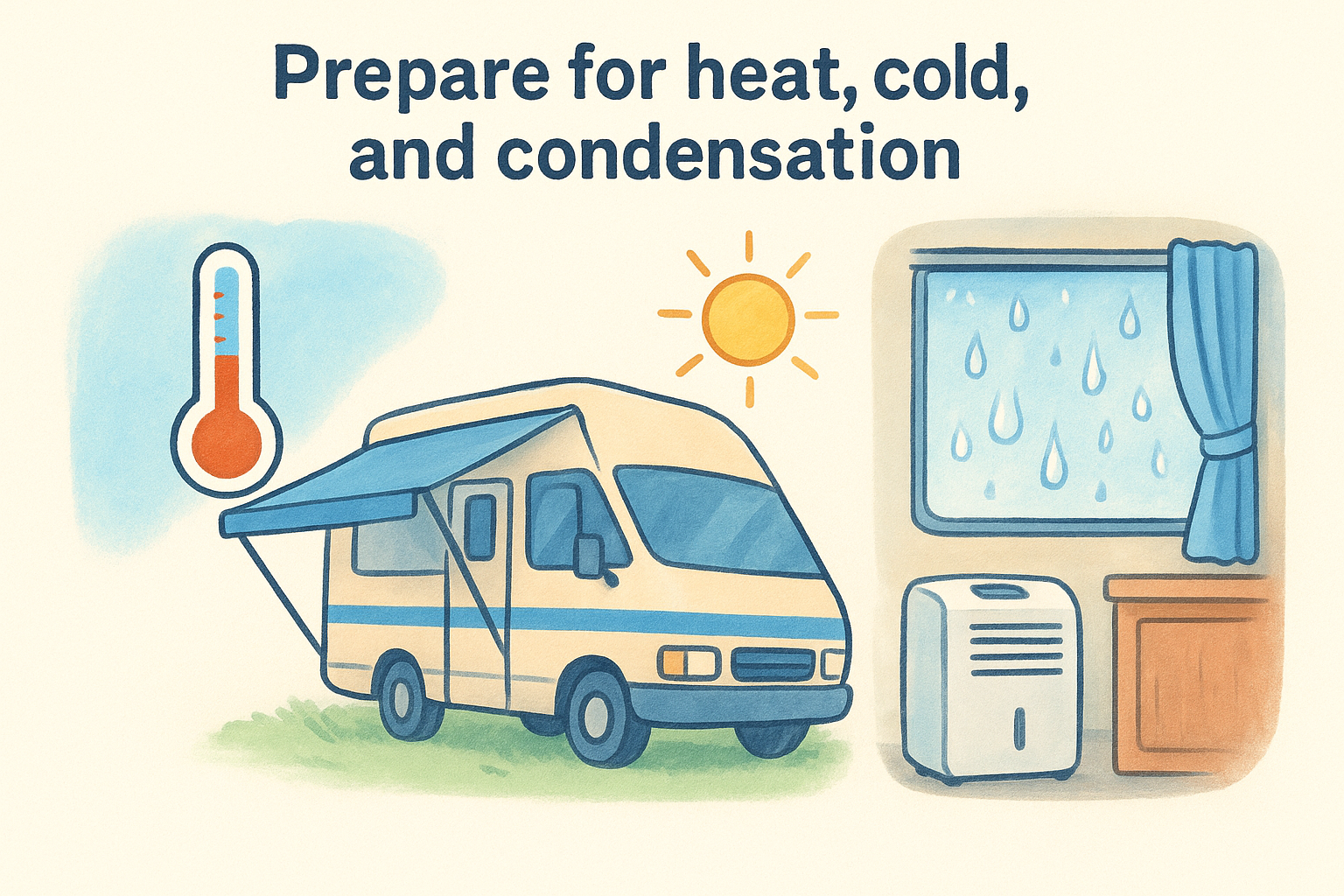
9. Prepare for heat, cold, and condensation
Temperature management is one of the most underestimated challenges in full-time RV living. Your rig's insulation is far thinner than a residential wall, which means extreme temperatures hit you faster and your HVAC system works harder to compensate. Among the full time rv living tips that protect both your comfort and your rig's structure, getting ahead of seasonal conditions before they arrive matters more than reacting after the damage is done.
Why it matters
Condensation is a specific threat that most beginners don't see coming. When warm interior air meets a cold surface, moisture forms on walls, windows, and inside cabinets, creating conditions for mold growth that can damage your rig's structure and your health within a single winter season.
Ignoring condensation for even one month can turn a fixable ventilation problem into a mold remediation bill that costs more than your monthly campground fees.
What to do
Run a small dehumidifier or crack a roof vent daily during cold weather to keep interior humidity below 50%. In summer, use reflective window covers and awnings to block radiant heat before it enters the rig, which reduces the load on your air conditioner significantly. Carry thermal curtains and skirting material for winter stays so your exposed underbelly retains heat when temperatures drop below freezing.
Rookie mistakes to avoid
Many beginners run their furnace constantly in winter without addressing condensation at the source, which actually worsens moisture buildup by cycling humid air. Another common error is parking in direct sun during summer without using any shade management, draining your power system while the interior stays uncomfortably hot.
10. Follow a preventive maintenance schedule
Reactive repairs cost two to three times more than preventive ones, and they always seem to happen at the worst possible moment. Among the full time rv living tips that protect your budget long-term, building and sticking to a scheduled maintenance routine is the one that consistently separates rigs that last a decade from those that become money pits.
Why it matters
Your RV takes significantly more punishment than a stationary home. Vibration, temperature swings, and constant road stress degrade seals, connections, and mechanical components at a rate most beginners don't anticipate. A roof seal that looks fine in spring can become a leak source by fall if you haven't inspected and resealed it on schedule.
Catching a failing roof seal before a rainstorm costs $30 in sealant. Replacing water-damaged cabinetry and subfloor after ignoring it costs thousands.
What to do
Build your maintenance schedule around specific mileage and time intervals, not vague reminders. Key tasks to track include:
- Monthly: Inspect all roof seals, check tire pressure and tread depth, test smoke and CO detectors
- Every 3 months: Lubricate slide rails, flush and treat holding tanks, check battery connections
- Annually: Service the generator, inspect brake pads, re-seal all exterior seams and windows
Keep a simple maintenance log in a notes app so you have a timestamped record for warranty claims and resale value.
Rookie mistakes to avoid
Many beginners skip roof inspections entirely because climbing up feels inconvenient. That single habit causes more water damage than any other neglected task. Another common error is treating every maintenance interval as flexible, pushing tasks back by weeks until they're forgotten completely.
11. Use the 3-3-3 and 4-4-4 rules to pace travel
Burning through destinations at maximum speed is one of the most common early mistakes among new full-timers. Among the full time rv living tips that protect both your sanity and your rig, pacing your travel with a structured rule keeps exhaustion and mechanical stress from compounding on each other.
Why it matters
The 3-3-3 rule means you drive no more than 300 miles per day, arrive by 3 PM, and stay at least 3 nights before moving on. The 4-4-4 rule applies the same logic at a slightly larger scale: 400 miles, arrive by 4 PM, stay 4 nights minimum. Both rules exist for the same reason: they force you to slow down before fatigue makes your decisions for you.
Arriving early gives you daylight to set up correctly, identify site issues, and locate a repair provider if something went wrong in transit before everything closes for the evening.
What to do
Pick whichever rule fits your travel style and apply it as a default framework on every trip leg, not just on long stretches. Build your route planning around arrival times first and mileage second, which changes how you select overnight stops and prevents you from choosing a campground that's 30 minutes too far just to save a few dollars.
Rookie mistakes to avoid
Many beginners treat these rules as optional suggestions they apply only when they feel tired, which misses the point entirely. Fatigue accumulates gradually, meaning you often don't notice how depleted you are until you've already made a poor driving decision or missed a mechanical warning sign on the road.
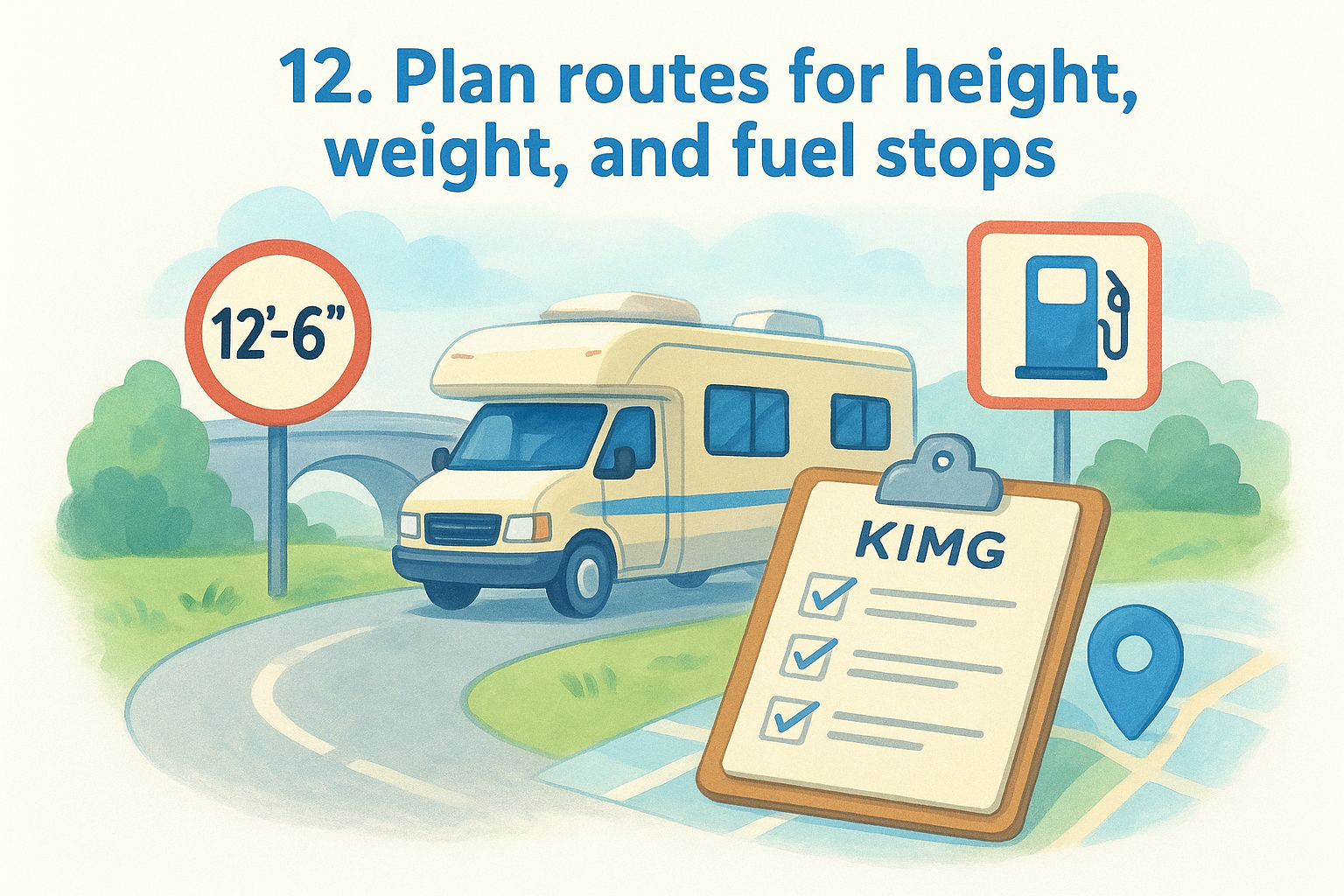
12. Plan routes for height, weight, and fuel stops
Route planning for an RV is not the same as planning a car trip. Among the full time rv living tips that prevent costly roadside surprises, knowing your exact height, weight, and fuel range before you leave each site keeps you from discovering a low bridge or a weight-restricted road after you're already committed to the lane.
Why it matters
Your rig has specific physical limits that road infrastructure was not always built to accommodate. Low bridges, weight-restricted roads, and narrow mountain passes can turn a standard driving day into a detour nightmare or, worse, a vehicle recovery situation. Fuel is equally critical because diesel and propane availability drops sharply in rural stretches where a passenger car can coast to the next town on fumes but a loaded coach cannot.
Knowing your rig's precise height and loaded weight before you leave home eliminates an entire category of driving emergencies that no roadside service can quickly fix.
What to do
Record your rig's exact height with all roof-mounted equipment and its loaded GVWR before your first trip. Use a dedicated RV GPS app that filters routes by height and weight restrictions, because standard navigation apps route you through clearances designed for passenger vehicles. Plan fuel stops every 150 miles in remote areas rather than waiting for your gauge to prompt you.
Rookie mistakes to avoid
Many beginners trust standard GPS apps like Google Maps for routing without accounting for bridge heights or road weight limits. Another common error is calculating rig height without including rooftop AC units, antennas, or solar panels, which adds several inches to your actual clearance requirement.
13. Book stays smarter in parks, cities, and public land
Where you sleep each night directly shapes your monthly budget and how rested you arrive at each destination. Among the full time rv living tips that affect your daily cost of living more than almost anything else, learning to mix campground types strategically gives you flexibility without blowing your budget on premium sites you don't need every night.
Why it matters
Paying full price for a private RV park every night is one of the fastest ways to drain your travel budget. Bureau of Land Management land and national forests offer free dispersed camping across millions of acres, and mixing those free nights with paid sites can cut your monthly lodging costs in half. City stops are often the most expensive, so planning your urban visits to last two or three nights rather than a week keeps costs manageable.
A well-mixed booking strategy routinely saves full-timers $200 to $400 per month compared to relying exclusively on private campgrounds.
What to do
Build your stays around three categories: free public land for off-grid stretches, membership parks like Thousand Trails or Passport America for discounted nights, and private campgrounds for full hookups when you need to recharge batteries, do laundry, or work remotely on a deadline. Book high-demand parks like national park campgrounds six months in advance, particularly for summer and holiday weekends.
Rookie mistakes to avoid
Many beginners book every night in advance on their first long trip, which removes the flexibility to extend a stay somewhere you love or skip a stop that doesn't suit you. Another common error is assuming free dispersed camping has reliable cell service, which affects both your work schedule and your ability to call for help if something goes wrong.
14. Protect your safety, gear, and personal security
Living on the road puts your personal safety and belongings in situations a fixed home never creates. Among the full time rv living tips beginners overlook most often, building a consistent security routine before your first long trip protects both your physical safety and your peace of mind at every campsite.
Why it matters
Your rig is simultaneously your home, your vehicle, and your storage unit and office, which makes it a target worth taking seriously. Campground theft happens regularly, particularly at busy sites near tourist areas where foot traffic is high and unfamiliar faces blend in easily.
A few low-cost security habits practiced every day protect your rig far better than expensive equipment you install once and never think about again.
What to do
Replace your factory entry door lock before your first trip, since most manufacturers ship units with the same key pattern across thousands of rigs. Beyond that change, layer in these additional measures:
- Add a hitch lock and wheel chock lock when parking for multiple nights
- Keep laptops and cameras in a small bolted-down safe inside a locked cabinet, not visible through windows
- Test your CO detector and fire extinguisher monthly, not just when you think of it
Rookie mistakes to avoid
Many beginners leave their entry door unlocked while sitting outside at the picnic table, assuming that being nearby is enough protection. Busy campgrounds near popular destinations see opportunistic theft regularly, and proximity alone does not deter it.
Another common error is storing propane tanks inside your rig during travel instead of keeping them in exterior compartments, which creates a fire risk that puts everyone at your campsite in danger.
15. Make internet reliable enough for real work
Reliable internet is no longer optional if you work remotely, run a business, or stay connected to family. Among the full time rv living tips that determine whether this lifestyle is financially sustainable long-term, building a redundant internet setup before you leave home is far easier than troubleshooting dead zones from a campsite with a deadline in two hours.
Why it matters
A single carrier's signal coverage looks excellent on a map but disappears fast in rural campgrounds, mountain corridors, and remote public land. Working from a single hotspot means one weak signal disrupts your entire day, your income, and your clients' confidence in your reliability.
Building two independent connections into your rig costs less than one lost contract from a missed deadline caused by a dropped signal.
What to do
Run at least two separate data sources so a dead signal on one carrier doesn't stop your work entirely. A practical setup for most full-time workers includes:
- Primary: A cellular router with a high-gain external antenna mounted to your rig, paired with an unlimited plan from your strongest regional carrier
- Backup: A second hotspot on a different carrier's network, since Verizon and T-Mobile cover different rural gaps
- Supplemental: Campground Wi-Fi as a third option for low-priority tasks only
Rookie mistakes to avoid
Many beginners rely exclusively on campground Wi-Fi, which is shared infrastructure that slows to unusable speeds during peak evening hours when every site streams video simultaneously. Another common mistake is buying a data plan based on home usage patterns rather than actual mobile consumption, which often leads to throttling right when you need bandwidth most.
16. Build community and protect your mental health
Full-time RV life delivers remarkable freedom and flexibility, but that freedom creates real isolation if you don't plan for social connection from the start. Many beginners treat community as a bonus feature rather than a foundational part of their lifestyle, and that oversight catches up with them faster than almost any mechanical failure.
Why it matters
Loneliness is one of the most common reasons people quit full-time RV living within the first year, and it catches people off guard because the early months feel exciting enough to mask it. When that novelty fades, the absence of a regular social circle, coworkers, or nearby family creates a genuine psychological weight that builds slowly and hits hard.
Protecting your mental health on the road is as practical as maintaining your roof seals, because both failures will stop your trip if you ignore them long enough.
What to do
Seek out RV communities before you feel isolated, not after. Join RV-specific groups on Facebook or attend rallies hosted by full-timer organizations where you can meet people who share your situation. If you work remotely, schedule regular video calls with friends and family on a fixed weekly cadence so connection stays intentional rather than occasional.
Rookie mistakes to avoid
Among the full time rv living tips that deserve more attention, many beginners skip building community entirely during the planning phase because it feels less urgent than budgeting or route planning. By the time isolation sets in, rebuilding social habits from scratch takes far more energy than maintaining them would have required from the start.
Next steps
These 16 full time rv living tips cover the decisions that separate beginners who thrive from those who burn out inside the first year. Your preparation window before departure is the most valuable planning time you have, and every item on this list gets easier to handle before you're rolling than after.
Start with the two that protect everything else: build your breakdown plan and lock in your maintenance schedule before you turn the key for the first time. Those two habits create a solid foundation that makes every other adjustment on the road far less stressful.
When parts needs or repair situations come up along the way, you can order RV parts directly online through MobileRVService.com without hunting down a dealership or waiting on a service center's timeline. Getting the right parts to your location fast is often what keeps a small problem from turning into a trip-ending one.