RV Air Conditioner Repair Service: Costs & Mobile Options
Your RV's air conditioner picks the worst possible moments to quit, mid-July, parked at a campground, with the nearest dealership service bay booked out for weeks. An RV air conditioner repair service can get your system diagnosed and fixed on-site, often the same day, so you're not sweating it out or cutting a trip short. The problem is knowing what repairs actually cost and whether a mobile technician can handle the job where you're parked.
AC issues range from simple fixes like a bad capacitor or a dirty filter to more involved work like compressor replacement or rooftop unit swaps. Repair costs vary widely depending on the diagnosis, and not every shop or mobile tech prices things the same way. Without a clear picture of what to expect, you're walking into estimates blind.
This article breaks down common RV air conditioner problems, what repairs typically cost, and when a mobile service makes more sense than hauling your rig to a shop. We'll also cover how to find a qualified technician through MobileRVService.com, where you can search over 3,200 mobile RV service providers across North America by zip code, designed to connect you with nearby help right where you're parked.
What an RV air conditioner repair service includes
A qualified RV air conditioner repair service covers more than just swapping parts. Technicians start with a full system diagnosis to identify why your unit stopped cooling, is cycling too fast, making noise, or tripping breakers before they touch anything else.
Diagnosis and troubleshooting
When a tech arrives, they check voltage at the unit, refrigerant pressure, airflow through the evaporator and condenser coils, and the condition of the start and run capacitors. Many A/C failures trace back to electrical components rather than the compressor itself, which is good news because capacitors and contactors cost a fraction of a full unit replacement.
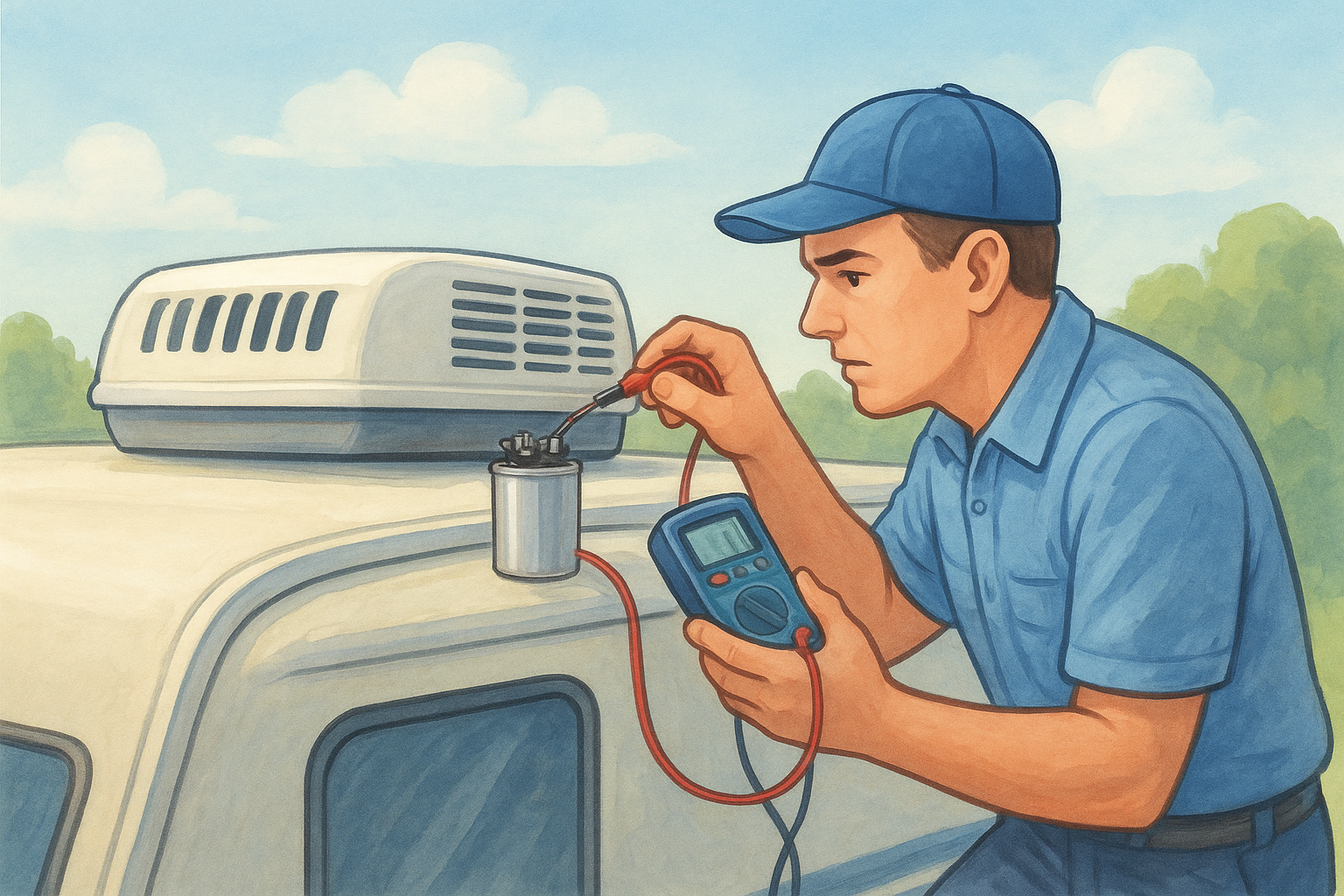
A proper diagnosis rules out expensive repairs before you commit to them, which can save you several hundred dollars on a single service call.
Common repairs a tech handles
Most problems that kill RV air conditioners fall into a short list. A technician can replace faulty capacitors, fan motors, thermostats, control boards, and shroud gaskets that seal the unit to your roof. They also flush and clean evaporator and condenser coils packed with dust, pollen, or campground debris, which is one of the most common reasons a unit blows warm air despite running otherwise fine.
Refrigerant leaks require a certified technician to recover, repair, and recharge the system. Not every mobile tech carries refrigerant handling certification, so confirm this before booking if you suspect a leak rather than an electrical or airflow problem.
Preventive maintenance checks
Routine maintenance is part of what a solid repair service offers alongside active fixes. A tech will inspect the rooftop gasket for cracks or shrinkage that lets water into your ceiling, clean or replace the air filter, check the drain pan, and test capacitor health before it fails. Catching a weak capacitor early typically costs under $50 in parts versus several hundred dollars for an emergency call when the unit quits mid-trip.
Scheduling a maintenance visit once per year, ideally before summer travel season starts, keeps your system running efficiently and gives you a clear baseline for spotting problems before they leave you stranded somewhere without a breeze.
Why fast RV A/C repair matters on the road
When your A/C fails during a trip, the problem is not just discomfort. High interior temperatures build quickly inside an RV, especially under direct sun, and the people and pets inside bear the full impact. Getting a qualified rv air conditioner repair service on-site fast is not a convenience issue; in extreme heat, it is a safety issue.
Heat becomes a health risk quickly
Temperatures inside a parked or stationary RV can reach dangerous levels within an hour when the A/C is down in summer conditions. Elderly travelers, children, and pets are at the highest risk, as heat exhaustion and heat stroke develop faster than most people expect. The CDC notes that heat-related illness is one of the most preventable causes of weather-related death, and enclosed spaces accelerate that risk significantly.
Do not wait to book a repair if outdoor temperatures are above 90°F and your A/C is completely out. Act the same day.
A broken A/C disrupts your entire trip
Lost cooling also means lost sleep, altered routes to avoid heat, and in many cases an early end to a trip you planned for months. Without a working system, you may need to move to a site with full hookups, find a hotel, or stay parked until a shop has availability. Mobile repair keeps you in place and on schedule rather than rerouting your entire itinerary around a dealership's service calendar.
Costs to repair or replace an RV A/C
Repair costs for a qualified rv air conditioner repair service depend on what's failing and who you book. Labor rates for mobile technicians typically run between $100 and $150 per hour, and most service calls carry a diagnostic fee of $75 to $150 on top of parts.
Typical repair costs
The parts involved in common A/C repairs cover a wide price range. Capacitor replacements sit at the lower end, usually $30 to $80 in parts plus about an hour of labor. Fan motor replacements run $100 to $250 in parts, and a control board swap can reach $200 to $400 depending on your unit's brand. Refrigerant recharging adds another $100 to $300 once you factor in recovery and recharge time.
Capacitor replacement $30–$80 $150–$280 Fan motor replacement $100–$250 $250–$450 Control board $200–$400 $350–$600 Refrigerant recharge $100–$300 $250–$500When replacement makes more sense
If repair quotes approach 60% of a new unit's cost, replacement is almost always the smarter financial call.
Full rooftop unit replacement runs $700 to $1,400 for the unit itself, with installation adding $200 to $400 in labor. Units older than 10 years with a failed compressor are nearly always cheaper to replace outright, since compressor parts alone cost $400 to $800 before your technician touches a single wire.
Mobile vs shop RV A/C repair options
Choosing between a mobile technician and a shop comes down to where you're parked, how serious the repair is, and how much time you have. Neither option is always the right call, but understanding the tradeoffs lets you make a faster, smarter decision when your A/C stops working.
When mobile repair works best
A mobile rv air conditioner repair service makes the most sense when you're at a campground, storage lot, or anywhere towing your RV is inconvenient or expensive. Most standard repairs, including capacitor swaps, fan motor replacements, and coil cleaning, are fully manageable on-site with the right tools. You save the haul cost, skip the dealership backlog, and stay in your campsite.
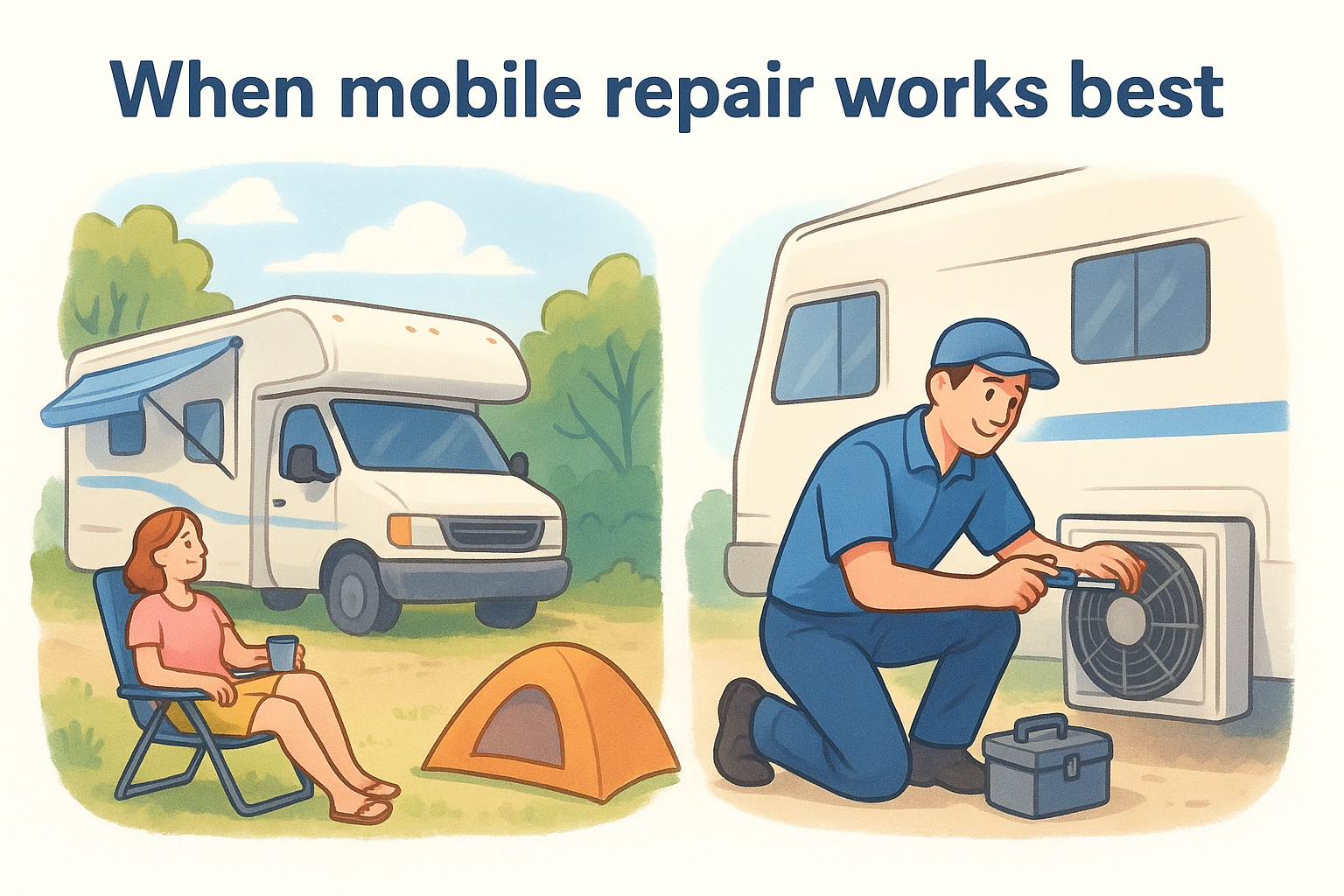
Mobile technicians also work around your schedule rather than a shop's service bay calendar. If you're traveling full-time or on a fixed itinerary, waiting a week for a shop opening is not a realistic option.
Mobile technicians handle the majority of RV A/C jobs without any need for a physical bay or lift equipment.
When a shop makes sense
Some repairs genuinely require a controlled shop environment or specialized equipment. Full rooftop unit replacements on tall Class A motorhomes benefit from a lift that keeps the work safe and precise. Shops also carry broader parts inventory on-site, which cuts turnaround time if your unit needs an uncommon control board or a specific compressor model that a mobile tech would need to order first.
If your warranty requires dealer service or your repair involves refrigerant recovery equipment most mobile techs don't carry, a shop visit is the practical choice.
How to find an RV A/C repair tech near you
Finding a qualified rv air conditioner repair service close to your current location is the first step, and your approach matters. Generic web searches often surface shop-based dealerships rather than mobile technicians who can actually come to your campsite, which wastes time when you need help fast.
Search by location, not by brand
MobileRVService.com lets you search over 3,200 mobile RV service providers across North America using your zip code. Enter your current location, filter by service category, and you get a list of nearby technicians with ratings and contact information ready to go.
Using a directory built specifically for mobile RV service cuts your search time significantly compared to calling dealerships one by one.
What to confirm before you book
Once you find a candidate, verify their specific experience with A/C systems before committing. Not every mobile tech carries refrigerant recovery equipment or holds EPA Section 608 certification, which is required for any work involving refrigerants under federal law. Ask directly whether they handle the specific repair you need.
Check ratings and reviews on the platform before you call. A technician with consistent five-star feedback on A/C work is a stronger choice than one with broad but unverified credentials. Ask about their diagnostic fee, hourly rate, and parts sourcing upfront so you have a complete cost picture before anyone shows up at your site.
Get your RV cool again
A broken A/C doesn't have to end your trip or force you into a dealership queue that stretches for weeks. Most RV air conditioner repair service calls come down to a handful of common failures, and a qualified mobile technician can diagnose and fix them right at your campsite. You now know what repairs cost, which issues justify replacing the unit outright, and when a shop visit actually makes sense over booking a mobile tech.
The fastest next step is searching for a technician near your current location before the heat inside your rig becomes a real problem. MobileRVService.com gives you direct access to over 3,200 mobile RV service providers across North America, filtered by zip code and service type. You can also explore RV owner membership benefits to see how concierge assistance and remote support options work if you can't locate a tech on your own.