How Long Do RV Generators Last? Hours, Years, Runtime
If you've ever been parked at a campground wondering how long do RV generators last, you're asking a question with two very different answers. One is about total lifespan, how many hours or years you can expect before the unit needs replacing. The other is about continuous runtime, or how long you can keep it running before you need to refuel or shut it down to prevent damage.
The short answer: a well-maintained RV generator typically lasts between 1,500 and 20,000 hours, depending on the type, brand, and how consistently you stay on top of service intervals. In terms of calendar years, that range can stretch anywhere from 8 to 20+ years for owners who treat maintenance as non-negotiable rather than optional.
Here at MobileRVService.com, we connect RV owners with mobile technicians across North America who can handle generator maintenance and repairs right at your campsite, no towing required. We've built a directory of over 3,200 service providers because we know that getting timely, professional care is what keeps RV systems running past their expected lifespan. Below, we'll break down generator longevity by type, what affects runtime on a single tank, and the maintenance habits that separate a generator that quits early from one that keeps producing power for decades.
Why RV generator lifespan matters
Understanding how long do RV generators last is not just a trivia question. It directly shapes your repair budget, your trip planning, and your decision to fix or replace a unit that starts showing problems. Knowing where your generator sits in its expected lifespan gives you a real advantage when a technician tells you a repair will cost $800 and you need to decide if that investment still makes sense.
The cost of unexpected failure
A generator that quits mid-trip creates a cascade of problems beyond the inconvenience. Your refrigerator stops running, which means food spoilage and a scramble to find a service provider who can reach you at a remote campsite. If you rely on a CPAP machine, air conditioning, or medical equipment, the stakes go up significantly. Unplanned generator failures are almost always more expensive than scheduled maintenance, both in direct repair costs and in secondary losses like spoiled food, extended campground fees, or last-minute service call premiums.
Treating your generator as a background appliance rather than a critical system is one of the fastest ways to find yourself stranded with a bill you didn't plan for.
Planning maintenance around your generator's age
Your generator's age in hours, not just calendar years, is the metric that determines when to service it and when to start budgeting for a replacement. A generator with 800 hours on it that belongs to a weekend camper has years of life ahead with proper care. That same unit sitting at 3,000 hours with inconsistent oil changes is a different story entirely. Tracking your hour meter and scheduling service around those numbers puts you in control of your maintenance costs rather than reacting to breakdowns.
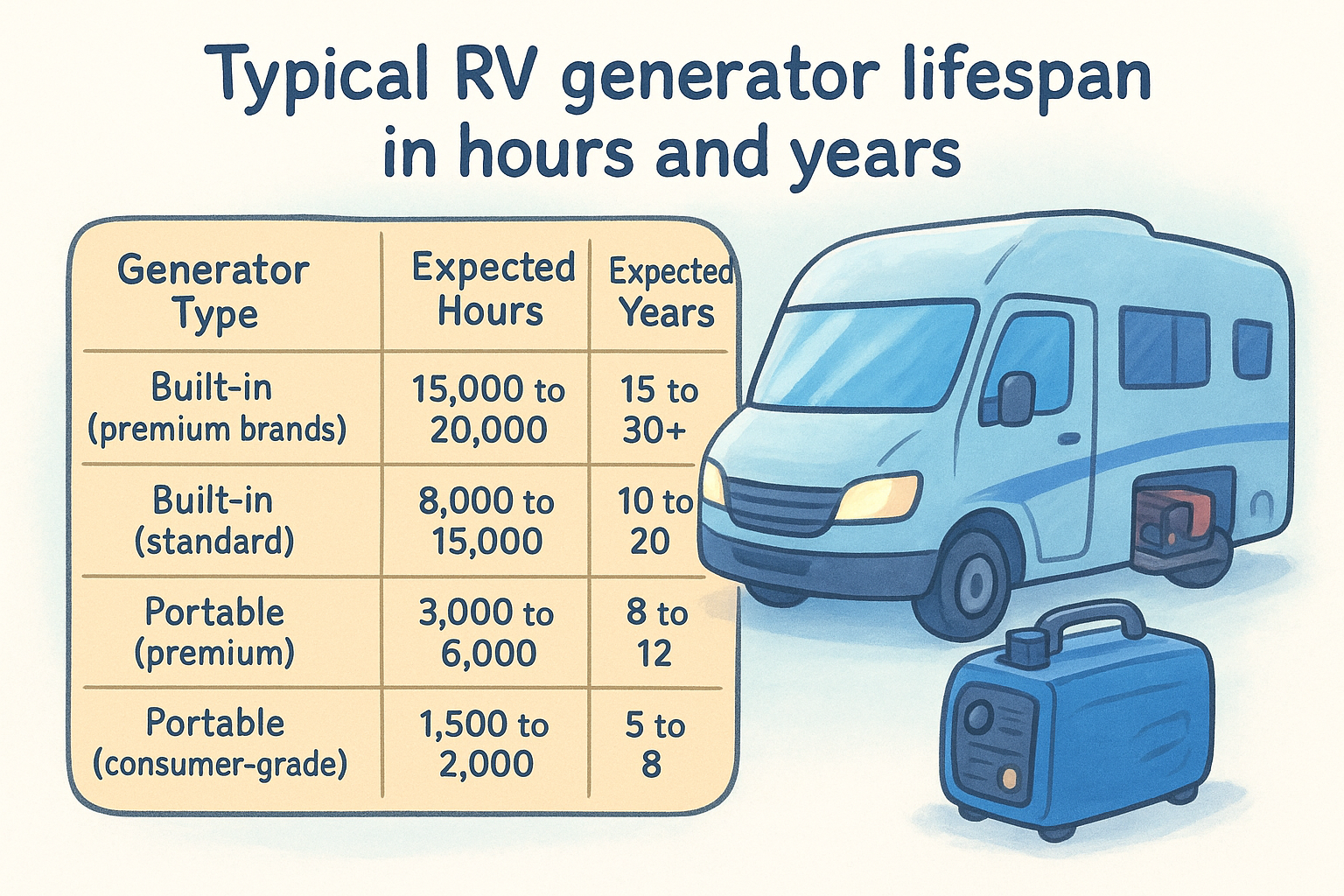
Typical RV generator lifespan in hours and years
When you ask how long do RV generators last, the answer depends on what type you own and how you use it. Built-in generators, like those from Onan or Cummins, sit at a much higher ceiling than portable units. The table below gives you a direct comparison of both types so you know exactly where your unit stands.
How hours convert to real years
Your actual yearly hour usage is the key variable in this calculation. A full-time RVer running the generator four to six hours daily can accumulate 1,000 to 2,000 hours per year, which burns through a consumer-grade portable unit in under two years. A weekend camper logging 200 hours annually gets dramatically more calendar life from the same machine.
Track your hour meter reading against the ranges above to get an honest picture of where your unit stands. If your generator has no hour meter, a mobile technician can estimate usage through an oil condition check and internal component inspection.
Buying a used RV? Always ask for the generator's hour meter reading before you agree on a price.
What shortens or extends RV generator life
Understanding how long do RV generators last in practice comes down to specific habits and conditions that either drain or preserve your unit's useful life. Two generators of the same model can land in very different places based entirely on how their owners operate and maintain them.
Habits that cut generator life short
Skipping oil changes is the single fastest way to reduce your generator's lifespan. Running a generator on dirty oil causes internal friction and heat buildup that wear down engine components well ahead of schedule. Loading the generator below 50% of its rated capacity for extended periods, sometimes called "wet stacking," forces the engine to run inefficiently and builds up carbon deposits over time.
Running your generator at 50-75% of its rated load produces cleaner combustion and significantly less internal wear.
Habits that add years to your generator
Consistent service intervals based on your hour meter, not the calendar, make the biggest difference in long-term reliability. Changing the oil every 100 to 150 hours, replacing the air filter on schedule, and running the generator under a proper load each time you use it keeps internal components clean and functioning correctly. Storing your generator with a fuel stabilizer when it sits unused for more than 30 days also prevents carburetor problems that are common after long breaks.
How long you can run an RV generator continuously
Continuous runtime is a separate question from how long do RV generators last overall. Most built-in RV generators can run for 8 to 24 hours on a single tank of fuel, depending on load demand and tank capacity. Portable generators typically run 4 to 8 hours before needing a refuel.
Never run your generator until it completely runs out of fuel, as fuel starvation can damage the carburetor and leave debris in the fuel system.
Heat buildup and recommended rest periods
Running your generator non-stop for more than 24 hours without a break is not advisable, even if fuel is available. Heat accumulates in the engine compartment over long continuous runs, and allowing a 30-minute cooldown period after extended use helps extend internal component life. Check your owner's manual for the manufacturer's specific continuous run rating, since that number varies by model.
Load and its effect on runtime
Higher electrical loads drain your fuel tank faster and generate more heat simultaneously. Running your air conditioner, microwave, and television at the same time shortens your runtime window compared to powering only essential items. Reducing your total load during long runs keeps fuel consumption down and gives your generator a longer, cooler operating window between shutdowns.
When repairs stop making sense
Part of understanding how long do RV generators last is knowing when you've reached the end of a unit's useful life. A good repair decision depends on comparing the repair cost against the generator's remaining value and expected hours. Once those numbers stop working in your favor, putting money into the unit becomes a losing trade.
Signs the math no longer works
A repair estimate that exceeds 50% of the replacement cost is the clearest signal that you should replace rather than fix. If a rebuilt carburetor, new voltage regulator, or engine overhaul costs $600 on a generator worth $900, you're better off starting fresh. Beyond cost, repeated failures within a short period tell you that one component giving out is not the real problem. When multiple systems start failing in sequence, the generator has simply reached the end of its design life.
If your technician finds corrosion, cracked housings, or worn internal components across multiple systems at once, a second repair bill is likely coming soon after the first.
Hour meter thresholds worth tracking
Portable generators past 2,000 hours and built-in units pushing beyond 15,000 hours deserve serious scrutiny before any major repair investment. At those thresholds, core engine components are near their wear limits, and a single repair rarely addresses what's coming next.
Next steps for a reliable generator
Now that you know how long do RV generators last across different types and usage patterns, the most valuable thing you can do is start tracking your hour meter today. Write down your current reading, set a service reminder at the next 100-hour mark, and commit to oil changes and filter replacements on that schedule rather than guessing based on the calendar.
Your second priority is finding a qualified technician you can call before something breaks, not after. Mobile technicians who specialize in RV systems can reach you at a campsite, perform a diagnostic inspection, and catch wear issues before they turn into roadside failures. If you're not sure where to find qualified help near your location, browse mobile RV service providers in your area and explore the membership options that give you priority access to vetted technicians across North America. Consistent professional maintenance is the most direct path to getting full life out of your generator.